
Many English learners wonder whether gases or gasses is the correct plural form. Although these words look very similar, they have different meanings and are used in different contexts. Understanding the distinction will help you write more accurately, avoid common grammar mistakes, and choose the correct word with confidence in everyday communication.
Gases Or Gasses: Comparison Overview
The confusion between gases and gases comes from their similar spelling. However, they are not interchangeable.
- Gases are the standard plural form of the noun gas, referring to substances like oxygen, nitrogen, or carbon dioxide.
- Gasses is the third-person singular form of the verb to gas, meaning to expose someone or something to gas or, in informal English, to talk excessively.
Although gases are much more common, gases is still a correct English word when used as a verb.
| Feature | Gases | Gasses |
| Part of Speech | Noun (Plural) | Verb (Third-person singular) |
| Meaning | More than one gas | Exposure to gas or talking excessively |
| Common Usage | Science, chemistry, environment | Military, medical, and informal speech |
| Frequency | Very common | Less common |
Definition of Gases
Gases is the plural form of the noun gas.
A gas is one of the basic states of matter. Unlike solids and liquids, gases have no fixed shape or volume and spread to fill any container.
Core Meaning
- More than one gas
- Refers to substances in gaseous form
- Used in science, medicine, engineering, and everyday conversation
Examples
- Oxygen and nitrogen are important gases in Earth’s atmosphere.
- Greenhouse gases contribute to climate change.
- Scientists studied several gases during the experiment.
Definition of Gases
Gasses is the third-person singular present tense of the verb gas.
It means someone exposes another person or place to gas. In informal English, it can also mean someone talks excessively or boasts.
Core Meaning
- Verb form of gas
- Means to be exposed to gas
- Can also mean talks continuously (informal)
Examples
- The factory gases the storage tanks before cleaning.
- He gasses everyone with stories about his travels.
Main Differences Between Gases and GGases
| Feature | Gases | Gasses |
| Word Type | Noun | Verb |
| Meaning | Multiple gases | The action of gassing |
| Used For | Objects or substances | Actions |
| Grammar Role | Subject or object | Predicate (verb) |
| Example | The gases expanded. | She gases the chamber. |
Key Differences
- Gases name things.
- Gasses describes an action.
- Gases appear far more often in everyday English.
- Gases are relatively rare outside specific contexts.
Why People Confuse Gases and Gasses
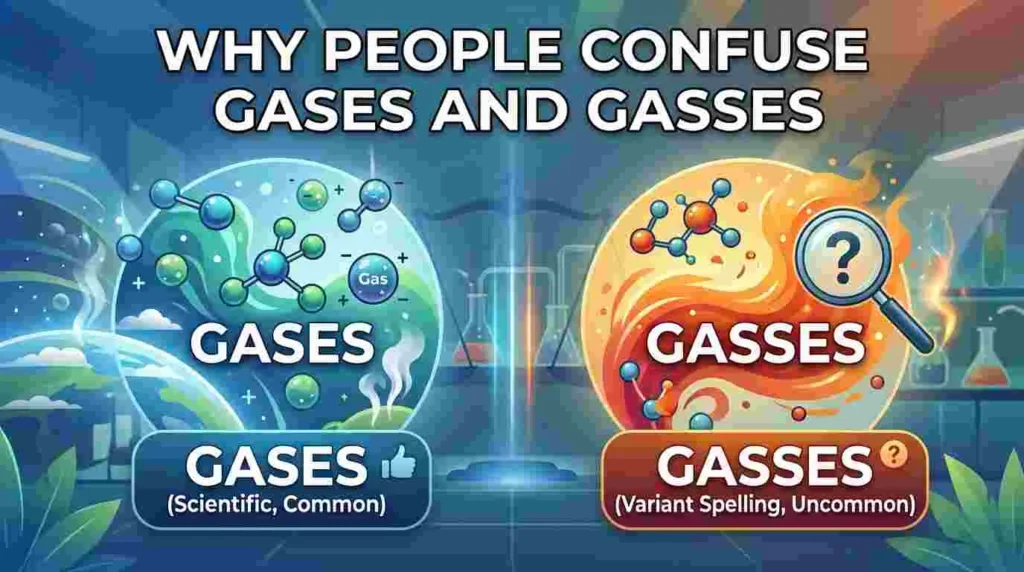
The confusion exists because both words come from gas.
Many nouns ending in -s form their plurals by adding -es, making gases.
Meanwhile, English verbs ending in -s often add -es in the third-person singular, producing gasses.
The spelling difference is only one extra s, but the grammar changes completely.
Gases Or Gasses: Comparison Table
| Question | Gases | Gasses |
| Is it a noun? | Yes | No |
| Is it a verb? | No | Yes |
| Refers to substances? | Yes | No |
| Refers to an action? | No | Yes |
| Common in science? | Yes | Rare |
| Common in grammar lessons? | Yes | Yes |
Grammar Guide
Understanding the grammar behind these words makes choosing the correct one much easier.
- Gas → singular noun
- Gases → plural noun
- Gas → verb
- Gases → third-person singular verb
How Each Term Is Used in Sentences
Gases
Pattern:
Plural noun
Examples:
- The gases escaped from the container.
- Different gases react differently under pressure.
- These gases are colorless.
- Scientists analyzed the gases carefully.
- Harmful gases pollute the air.
Gasses
Pattern:
Subject + gasses + object
Examples:
- The technician gases the equipment.
- The machine gases the chamber.
- He gases the insects before testing.
- She gases the balloons safely.
- Tom gasses everyone with endless jokes.
Common Mistakes Learners Make
Mistake 1
❌ The atmosphere contains many gases
✅ The atmosphere contains many gases.
Mistake 2
❌ The scientist studies dangerous gases. ✅ The scientist studies dangerous gases.
Mistake 3
❌ He gases the room.
✅ He gases the room.
Mistake 4
Using gases as a plural noun.
Incorrect because gases is a verb, not a plural noun.
Simple Rules to Remember
- Gases = plural noun
- Gasses = verb
- If you’re talking about substances, choose gases.
- If you’re describing someone’s action, choose gases.
Easy memory trick:
Gases = Things
Gasses = Actions
Quick Tips for Writing and Speaking
- Think about whether you need a noun or a verb.
- Scientific writing almost always uses gases.
- Check whether the word follows a subject acting.
- Remember that gases usually need an object.
- Proofread carefully because spell-checkers may not catch this mistake.
When to Use Each One
Use “Gases” When
- Talking about chemistry
- Discussing the atmosphere
- Writing scientific reports
- Describing different substances
- Mentioning greenhouse gases
- Explaining states of matter
- Writing educational content
Examples
- Greenhouse gases trap heat.
- Noble gases rarely react.
- Several gases escaped.
Use “Gases” When
- Describing the action of exposing something to gas as
- Talking about industrial processes
- Referring to military or medical procedures
- Using the informal meaning of talking too much
Examples
- The worker gases the container.
- She gasses everyone with funny stories.
When NOT to Use Each One
Do NOT Use “Gases”
- As a verb
- To describe an action
Incorrect:
- He gases the room.
Correct:
- He gases the room.
Do NOT Use “Gases”
- As the plural of gas
- In scientific writing, referring to substances
Incorrect:
- These harmful gases spread quickly.
Correct:
- These harmful gases spread quickly.
Which One to Use (Decision Guide)
Ask yourself these questions:
Are you talking about more than one gas?
➡ Use gases.
Are you describing someone’s action of exposing something to gas?
➡ Use gases.
Are you writing about chemistry or science?
➡ Almost certainly gases.
Does the word describe what someone does?
➡ Use ggases
Real-World Practical Examples
Gases Examples
- Scientists measured atmospheric gases during the experiment.
- Hospitals use medical gases every day.
- Greenhouse gases affect global temperatures.
- Different gases behave differently under pressure.
- Engineers tested industrial gases before production.
Gasses Examples
- The technician gases the chamber before testing.
- The company uses storage tanks for safety.
- He gasses his friends with endless stories.
- The farmer gases the greenhouse to remove pests.
- The operator gases the equipment before maintenance.
Self-Assessment (Fill in the Blanks)
- I will use ______ when referring to substances in the atmosphere.
The correct word is ______ because it is a plural noun. - I will use ______ when describing an action performed by a worker.
The correct word is ______ because it is a verb. - I studied different ______ in chemistry.
The correct word is ______ because multiple substances are discussed. - The technician ______ the chamber carefully.
The correct word is ______ because it describes an action. - Greenhouse ______ trap heat.
The correct word is ______ because it is a plural noun. - The machine ______ the storage room.
The correct word is ______ because it is a verb. - Noble ______ rarely react chemically.
The correct word is ______ because they are substances. - He ______ everyone with long speeches.
The correct word is ______ because it means talks excessively. - The laboratory stores several ______.
The correct word is ______ because it refers to multiple gases. - The operator ______ the tank before cleaning.
The correct word is ______ because it describes an action. - Scientists compare different ______.
The correct word is ______ because it is plural. - She ______ the container safely.
The correct word is ______ because it is a verb. - Air contains many ______.
The correct word is ______ because it refers to substances. - The worker ______ the chamber every morning.
The correct word is ______ because it expresses an action. - Toxic ______ require careful handling.
The correct word is ______ because they are substances. - He ______ the room before inspection.
The correct word is ______ because it is a verb. - Several invisible ______ filled the container.
The correct word is ______ because it is plural. - The engineer ______ the equipment before testing.
The correct word is ______ because it is an action. - Industrial ______ are transported safely.
The correct word is ______ because they are substances. - The employee ______ the storage area as instructed.
The correct word is ______ because it is a verb.
Answers
- gases — plural noun
- gasses — verb
- gases — plural noun
- gases — action
- gases — plural noun
- gasses — verb
- gases — plural noun
- gasses — verb
- gases — plural noun
- gasses — verb
- gases — plural noun
- gasses — verb
- gases — plural noun
- gasses — verb
- gases — plural noun
- gasses — verb
- gases — plural noun
- gasses — verb
- gases — plural noun
- gasses — verb
Final Verdict
Although gases and gases differ by only one letter, they have completely different grammatical roles. Gases is the correct plural form of the noun gas and is the word you’ll almost always use when discussing chemistry, science, the environment, medicine, or everyday topics involving multiple gases. Gases, on the other hand, is the third-person singular form of the verb to gas, meaning to expose something to gas or, informally, to talk excessively. Before choosing between them, ask whether you need a noun or a verb. If you’re naming substances, use gases. If you’re describing an action, use phrases. Remembering this simple distinction will help you write and speak with greater accuracy and confidence.
Conclusion
Understanding the difference between gases and gasses is easier once you know the role each word plays in a sentence. Gases is the correct plural form of the noun gas, making it the right choice when referring to substances like oxygen, hydrogen, or greenhouse gases. Gasses, on the other hand, is a verb that describes the act of exposing something to gas or, in informal usage, talking excessively. Since these words differ by only one letter, they are often confused, but remembering whether you need a noun or a verb will help you make the correct choice every time. Whether you’re writing a science report, improving your grammar, or simply polishing your English, using these terms accurately makes your communication clearer and more professional. With regular practice and attention to context, you’ll be able to choose between gases and gasses confidently in both writing and everyday conversation.
FAQs
What is the difference between gases and gases?
Gases are the plural form of the noun gas and refer to multiple gaseous substances. Gasses is the third-person singular form of the verb gas, meaning to expose someone or something to gas or, informally, to talk at length. The correct choice depends on whether you need a noun or a verb.
Is gases the correct plural of gas?
Yes, gases is the standard and correct plural form of gas. It is widely used in scientific, educational, environmental, and everyday contexts when referring to more than one gas, such as oxygen, carbon dioxide, or noble gases.
Is gasses a real English word?
Yes, gases is a real English word. It is the present tense verb form of gas used with third-person singular subjects, such as “he gasses” or “the machine gasses.” It is not used as the plural form of the noun gas.
Why do people confuse gases and gasses?
People often confuse these words because they are spelled almost the same. However, gases is a plural noun, while gasses is a verb. Knowing the grammatical role of the word in the sentence makes it much easier to choose the correct spelling.
Which word is used in science, gases or gasses?
In science, gases are almost always the correct word because it refers to substances in the gaseous state. You will commonly see it in chemistry, biology, physics, environmental studies, and engineering when discussing different types of gases.
Can I use gases instead of gases?
No. You should not replace gases with gases when referring to multiple gaseous substances. Doing so creates a grammatical error because gasses functions as a verb rather than a plural noun.
How can I remember the difference between gases and gases?
A simple way to remember is that gases name things, while gases describe an action. If you’re talking about substances like oxygen or helium, use gases. If someone is acting gassy, use gases.
Are gases commonly used in everyday English?
Not very often. Gases appear mainly in technical, industrial, medical, or military writing, and occasionally in informal speech, meaning someone talks excessively. For most everyday situations, you’ll encounter gases much more frequently.
Are gases and gases pronounced differently?
Generally, they are pronounced very similarly in everyday speech, which adds to the confusion. Because pronunciation offers little help, paying attention to the sentence meaning and grammar is the best way to choose the correct spelling.
Which word should I use in formal writing?
In formal writing, choose the word based on its grammatical function. Use gases when referring to multiple gaseous substances and gases only when describing the action of exposing something to gas. Careful usage improves clarity and grammatical accuracy.

