
Feeling anxious is a common human experience, but describing it in fresh, vivid ways can make your writing more engaging and relatable. The Best Similes for Anxious help readers instantly understand nervousness, worry, fear, or uneasiness through creative comparisons. Whether you’re writing a story, poem, essay, speech, or conversation, these similes add emotion and depth. In this guide, you’ll learn what similes are, why they matter, different types, and discover 30 original similes with meanings, explanations, and examples you can use confidently.
Definition of Similes For Anxious
Best Similes For Anxious are comparisons that describe feelings of worry, nervousness, fear, or unease by using the words “like” or “as.” They help readers picture emotions more clearly and make writing more expressive and memorable.
What Is a Simile?
A simile compares one thing to another by using like or as. It helps readers imagine feelings, actions, or objects in a vivid and easy-to-understand way.
Example
- As nervous as a cat in a room full of rocking chairs.
- Like a leaf trembling in the wind.
- As quiet as falling snow.
- Like a ship lost in thick fog.
- As bright as the morning sun.
Why Use Analogies for Anxiety in Writing?
- They make emotions easier to understand.
- They create stronger mental images.
- They improve storytelling.
- They make characters feel realistic.
- They keep readers emotionally connected.
- They make essays and creative writing more engaging.
- They help avoid repeating the word “anxious.”
- They add creativity without making sentences difficult.
Types of Similes
Different similes create different emotional effects. Some describe physical reactions, while others focus on thoughts, nature, or dramatic situations.
Nature-Based Similes
Nature comparisons make anxiety feel vivid and relatable.
Example
- Like a leaf shaking in the wind.
- As restless as waves before a storm.
- Like clouds gathering before rain.
- As fragile as a spider’s web in the breeze.
Animal-Based Similes
Animal behavior often reflects nervousness and alertness.
Example
- Like a rabbit hearing footsteps.
- As cautious as a deer near a hunter.
- Like a bird trapped indoors.
- As jumpy as a squirrel crossing a road.
Everyday-Life Similes
These comparisons use familiar situations that everyone understands.
Example
- Like waiting for exam results.
- As uneasy as someone expecting bad news.
- Like holding a glass about to fall.
- As tense as a stretched rubber band.
Dramatic Similes
These similes create a stronger emotional impact.
Example
- Like standing on the edge of a cliff.
- As frozen as someone caught in headlights.
- Like walking across thin ice.
- As tight as a knot that won’t loosen.
Writing Tips and Common Mistakes
Useful Tips
- Choose comparisons your readers understand.
- Match the simile to the mood of your writing.
- Keep comparisons simple.
- Use fresh, original imagery.
- Avoid using several similes in one sentence.
- Read your sentence aloud to check its flow.
- Use similes naturally instead of forcing them.
Common Mistakes to Avoid
- Using overused similes too often.
- Mixing unrelated comparisons.
- Making similes too long.
- Comparing things that don’t logically connect.
- Repeating the same simile throughout an article.
- Adding unnecessary adjectives.
- Using a dramatic simile for a casual situation.
30 Best Similes For Anxious
Like a leaf trembling before a storm
Meaning: Feeling nervous before something important.
Detailed Explanation: Just as a leaf shakes before strong winds arrive, an anxious person often reacts before anything actually happens.
Tone: Poetic
Examples
- She stood like a leaf trembling before a storm before her interview.
- He looked like a leaf trembling before a storm while waiting outside.
- I felt like a leaf trembling before a storm all morning.
As restless as waves before high tide
Meaning: Unable to stay calm.
Detailed Explanation: Anxiety often causes constant movement and racing thoughts.
Tone: Descriptive
Examples
- She was as restless as waves before high tide.
- His mind stayed as restless as waves before high tide.
- I became as restless as waves before high tide.
Like a rabbit hearing distant footsteps
Meaning: Easily frightened.
Detailed Explanation: Rabbits stay alert to danger, much like anxious people.
Tone: Natural
Examples
- He jumped like a rabbit hearing distant footsteps.
- She looked around like a rabbit hearing distant footsteps.
- I froze like a rabbit hearing distant footsteps.
As tight as a pulled bowstring
Meaning: Extremely tense.
Detailed Explanation: Anxiety makes muscles and emotions feel stretched.
Tone: Dramatic
Examples
- My shoulders felt as tight as a pulled bowstring.
- He stayed as tight as a pulled bowstring.
- She remained as tight as a pulled bowstring all day.
Like a candle flickering in the wind
Meaning: Feeling uncertain.
Detailed Explanation: Anxiety can make confidence feel unstable.
Tone: Poetic
Examples
- Her confidence flickered like a candle in the wind.
- I stood like a candle flickering in the wind.
- He smiled like a candle flickering in the wind.
As uneasy as thin ice underfoot
Meaning: Feeling unsafe.
Detailed Explanation: Thin ice creates uncertainty, just like anxiety.
Tone: Serious
Examples
- I felt as uneasy as thin ice underfoot.
- She walked as uneasily as thin ice underfoot.
- They waited as uneasily as thin ice underfoot.
Like a bird trapped in a room
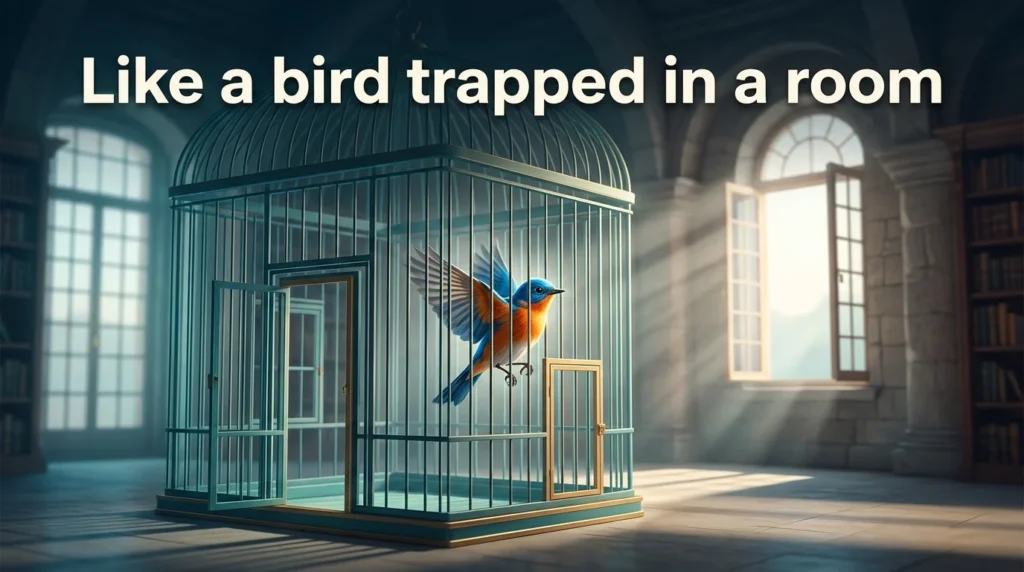
Meaning: Feeling panicked.
Detailed Explanation: A trapped bird desperately searches for escape.
Tone: Dramatic
Examples
- My thoughts flew like a bird trapped in a room.
- She looked like a bird trapped in a room.
- He moved like a bird trapped in a room.
As shaky as a bridge in strong wind
Meaning: Lacking confidence.
Detailed Explanation: Anxiety weakens emotional stability.
Tone: Dramatic
Examples
- His voice became as shaky as a bridge in strong wind.
- She sounded as shaky as a bridge in strong wind.
- I felt as shaky as a bridge in a strong wind.
Like a balloon ready to burst
Meaning: Overwhelmed by pressure.
Detailed Explanation: Anxiety builds until emotions feel ready to explode.
Tone: Emotional
Examples
- I felt like a balloon ready to burst.
- She looked like a balloon ready to burst.
- He stayed like a balloon ready to burst.
As nervous as a student before final exams
Meaning: Extremely worried.
Detailed Explanation: Many students experience anxiety before major exams.
Tone: Relatable
Examples
- She was as nervous as a student before final exams.
- I felt as nervous as a student before final exams.
- He looked as nervous as a student before final exams.
Like a fish out of water
Meaning: Feeling uncomfortable.
Detailed Explanation: Anxiety often appears in unfamiliar situations.
Tone: Casual
Examples
- I felt like a fish out of water.
- She looked like a fish out of water.
- He acted like a fish out of water.
As jumpy as popcorn in a hot pan
Meaning: Easily startled.
Detailed Explanation: Anxiety causes quick reactions.
Tone: Humorous
Examples
- She was as jumpy as popcorn in a hot pan.
- He became as jumpy as popcorn in a hot pan.
- I stayed as jumpy as popcorn in a hot pan.
Like clouds gathering before rain
Meaning: Expecting trouble.
Detailed Explanation: Anxiety often grows before events happen.
Tone: Poetic
Examples
- My worries gathered like clouds before rain.
- She felt like clouds gathering before rain.
- He watched like clouds gathering before rain.
As fragile as glass in a crowded room
Meaning: Emotionally vulnerable.
Detailed Explanation: Anxiety makes people feel easily hurt.
Tone: Emotional
Examples
- I felt as fragile as glass in a crowded room.
- She remained as fragile as glass in a crowded room.
- He looked as fragile as glass in a crowded room.
Like a clock ticking too loudly
Meaning: Constant worry.
Detailed Explanation: Anxiety makes every second feel longer.
Tone: Thoughtful
Examples
- Time sounded like a clock ticking too loudly.
- My thoughts echoed like a clock ticking too loudly.
- He waited like a clock ticking too loudly.
As cautious as a deer at the river
Meaning: Very careful.
Detailed Explanation: Anxiety makes people alert.
Tone: Natural
Examples
- She moved as cautiously as a deer at the river.
- I felt as cautious as a deer at the river.
- He looked as cautious as a deer at the river.
Like a kite caught in tangled branches
Meaning: Feeling stuck.
Detailed Explanation: Anxiety makes it difficult to move forward.
Tone: Reflective
Examples
- I felt like a kite caught in tangled branches.
- She remained like a kite caught in tangled branches.
- He looked like a kite caught in tangled branches.
As silent as someone holding their breath
Meaning: Waiting nervously.
Detailed Explanation: Anxiety often creates tense silence.
Tone: Dramatic
Examples
- The room stayed as silent as someone holding their breath.
- I waited as silently as someone holding their breath.
- She stood as silent as someone holding their breath.
Like a boat drifting in thick fog
Meaning: Feeling uncertain.
Detailed Explanation: Anxiety makes the future unclear.
Tone: Poetic
Examples
- I felt like a boat drifting in thick fog.
- She wandered like a boat drifting in thick fog.
- He looked like a boat drifting in thick fog.
As uneasy as an unlocked door at night
Meaning: Feeling insecure.
Detailed Explanation: Anxiety often creates a sense of vulnerability.
Tone: Serious
Examples
- She felt as uneasy as an unlocked door at night.
- I remained as uneasy as an unlocked door at night.
- He looked as uneasy as an unlocked door at night.
Like a thread ready to snap
Meaning: Nearly losing control.
Detailed Explanation: Anxiety stretches emotional strength.
Tone: Emotional
Examples
- I felt like a thread ready to snap.
- She remained like a thread ready to snap.
- He looked like a thread ready to snap.
As uncertain as footsteps in darkness
Meaning: Unsure about what comes next.
Detailed Explanation: Anxiety often comes from uncertainty.
Tone: Reflective
Examples
- I felt as uncertain as footsteps in darkness.
- She remained as uncertain as footsteps in darkness.
- He walked as uncertain as footsteps in darkness.
Like a compass spinning wildly
Meaning: Feeling confused.
Detailed Explanation: Anxiety can cloud judgment.
Tone: Creative
Examples
- My thoughts spun like a compass spinning wildly.
- She looked like a compass spinning wildly.
- He felt like a compass spinning wildly.
As delicate as frost in sunlight
Meaning: Easily overwhelmed.
Detailed Explanation: Anxiety can make confidence disappear quickly.
Tone: Gentle
Examples
- I felt as delicate as frost in sunlight.
- She stayed as delicate as frost in sunlight.
- He appeared as delicate as frost in sunlight.
Like an echo that never fades
Meaning: Persistent worry.
Detailed Explanation: Anxiety often repeats the same fears.
Tone: Reflective
Examples
- My worries stayed like an echo that never fades.
- She thought like an echo that never fades.
- He remembered like an echo that never fades.
As tense as a rope pulled from both ends
Meaning: Under pressure.
Detailed Explanation: Anxiety creates emotional strain.
Tone: Dramatic
Examples
- I felt as tense as a rope pulled from both ends.
- She remained as tense as a rope pulled from both ends.
- He looked as tense as a rope pulled from both ends.
Like rain tapping endlessly on a window
Meaning: Constant anxious thoughts.
Detailed Explanation: Worries continue without stopping.
Tone: Poetic
Examples
- My thoughts came like rain tapping endlessly on a window.
- She worried like rain tapping endlessly on a window.
- He waited like rain tapping endlessly on a window.
As watchful as an owl before dawn
Meaning: Constantly alert.
Detailed Explanation: Anxiety keeps people attentive.
Tone: Natural
Examples
- She remained as watchful as an owl before dawn.
- I stayed as watchful as an owl before dawn.
- He looked as watchful as an owl before dawn.
Like a shadow that follows every step
Meaning: Anxiety never seems to leave.
Detailed Explanation: Worry can feel constant.
Tone: Reflective
Examples
- Fear followed me like a shadow that follows every step.
- She carried worry like a shadow that follows every step.
- He lived like a shadow that follows every step.
As pale as the first light before sunrise
Meaning: Showing visible nervousness.
Detailed Explanation: Anxiety sometimes affects appearance.
Tone: Descriptive
Examples
- She became as pale as the first light before sunrise.
- I looked as pale as the first light before sunrise.
- He appeared as pale as the first light before sunrise.
Top 10 Best Similes For Anxious
| Simile | Meaning | Tone |
| Like a leaf trembling before a storm | Nervous before an event | Poetic |
| As restless as waves before high tide | Unable to stay calm | Descriptive |
| Like a rabbit hearing distant footsteps | Easily frightened | Natural |
| As tight as a pulled bowstring | Extremely tense | Dramatic |
| Like a candle flickering in the wind | Feeling uncertain | Poetic |
| As uneasy as thin ice underfoot | Feeling unsafe | Serious |
| Like a bird trapped in a room | Feeling panicked | Dramatic |
| Like a balloon ready to burst | Overwhelmed by pressure | Emotional |
| As nervous as a student before final exams | Extremely worried | Relatable |
| Like a compass spinning wildly | Feeling confused | Creative |
Conclusion
Finding the Best Similes For Anxious can transform ordinary writing into something vivid, memorable, and emotionally engaging. Whether you’re writing a story, poem, essay, or even a personal journal, the right simile helps readers connect with feelings of nervousness, worry, or uncertainty in a meaningful way. Instead of simply saying someone feels anxious, creative comparisons paint a clear picture that brings emotions to life. From nature-inspired expressions to everyday comparisons, each simile offers a fresh way to describe different levels of anxiety while keeping your writing natural and relatable.
The key is to choose similes that match the tone and context of your work without overusing them. With practice, you’ll build a stronger vocabulary and write with greater confidence and creativity. Keep exploring new comparisons, experiment with your own ideas, and let these Best Similes For Anxious add depth, emotion, and personality to every piece of writing you create.
FAQs
What are the best similes for anxious?
The best similes for anxiety compare nervous feelings to familiar situations using words like “like” or “as.” Examples include “like a leaf trembling before a storm” and “as tight as a pulled bowstring.” These comparisons make emotions easier to imagine and create stronger, more engaging writing.
What is a simile for anxious?
A simile for anxious is a figure of speech that compares anxiety to another object or situation using “like” or “as.” It helps readers picture emotions clearly, making stories, essays, and conversations more vivid and expressive.
Why should I use similes to describe anxiety?
Similes make writing more descriptive by helping readers visualize emotions instead of simply reading about them. They add creativity, improve storytelling, strengthen emotional impact, and make characters or situations feel more realistic and memorable.
Are similes for anxiety useful in creative writing?
Yes. Similes are widely used in creative writing because they bring emotions to life. They help readers connect with characters, create stronger imagery, and make scenes more engaging without using complicated language.
Can students use similes for anxiety in school assignments?
Absolutely. Students can use similes in essays, stories, speeches, and classroom activities to improve vocabulary and writing quality. Using appropriate similes also shows creativity while making ideas easier for readers to understand.
What makes a good simile for anxiety?
A good simile is clear, natural, and easy to understand. It should match the situation and create a vivid mental image without sounding forced. Simple comparisons often have the strongest impact on readers.
Can I create my own similes for anxious?
Yes. Creating your own similes is a great way to make your writing original. Think about objects, animals, or situations that remind you of nervousness, then compare them using “like” or “as” in a meaningful way.
What’s the difference between a simile and a metaphor?
A simile compares two things using “like” or “as,” while a metaphor says one thing is another without those words. Both make writing more descriptive, but similes create direct comparisons that are often easier for readers to understand.
Are nature-based similes effective for describing anxiety?
Yes. Nature-based similes work well because many people relate to images such as shaking leaves, gathering clouds, or rough waves. These familiar scenes make anxious emotions feel more vivid and emotionally meaningful.
How can I avoid overusing similes in my writing?
Use similes only when they add value to your message. Choose unique comparisons, vary your descriptions, and avoid placing too many similes in one paragraph. A few well-chosen similes create a stronger impression than using them repeatedly.