Amazing similes help young writers make their sentences more colorful, creative, and memorable. A well-written simile compares two different things using the words “like” or “as,” making ideas easier to imagine. Whether you’re writing stories, essays, speeches, or poems, similes can improve your writing style and keep readers engaged.
In these simile examples for students, you’ll discover simple explanations, practical writing tips, different types of comparisons, and 30 original examples that students can easily understand and use in school.
What Is a Simile? Examples for Students
A simile is a figure of speech that compares two different things using the words “like” or “as.” These comparisons help students express ideas more clearly by connecting a person, place, object, or feeling to something with a similar quality.
For example:
- “She is as busy as a bee.”
- “The water was as clear as glass.”
These comparisons create vivid pictures in the reader’s mind and make writing more interesting.
How Do Similes Help Students Improve Their Writing?
A simile is a figure of speech that compares two different things using like or as. Writers use similes to help readers understand descriptions through familiar comparisons. Students can also explore Similes for Complex Ideas to understand how comparisons make difficult concepts easier to describe.
Example
- As bright as the morning sun.
- Like a bird flying freely.
- As gentle as falling snow.
- Like a rainbow after rain.
- As calm as a quiet lake.
- Like a rocket taking off.
- As soft as cotton.
- Like a feather floating in the wind.
How Can Similes Help Students Write Better Sentences?
- Make writing more interesting.
- Help readers imagine descriptions easily.
- Improve storytelling skills.
- Add emotion and creativity.
- Make essays and poems more engaging.
- Strengthen descriptive vocabulary.
- Help students express ideas clearly.
- Keep readers interested from beginning to end.
Types of Metaphors: Examples For Students
Writers use different types of similes, examples for students, depending on what they want to describe.
Nature Similes
Nature similes compare people or objects with elements found in nature. Explore Similes To Describe Stars to discover more creative comparisons for descriptive writing.
Example
- As bright as the sun.
- As calm as the sea.
- Like falling leaves.
- As fresh as spring flowers.
- Like rolling clouds.
Animal Similes
Animal similes compare qualities with animals.
Example
- As brave as a lion.
- As busy as a bee.
- As quick as a rabbit.
- Like a soaring eagle.
- As gentle as a lamb.
Everyday Object Similes
These compare things with common objects that students see every day.
Example
- As sharp as a pencil.
- Like a shiny mirror.
- As smooth as silk.
- Like a bouncing ball.
- As light as paper.
Emotion Similes
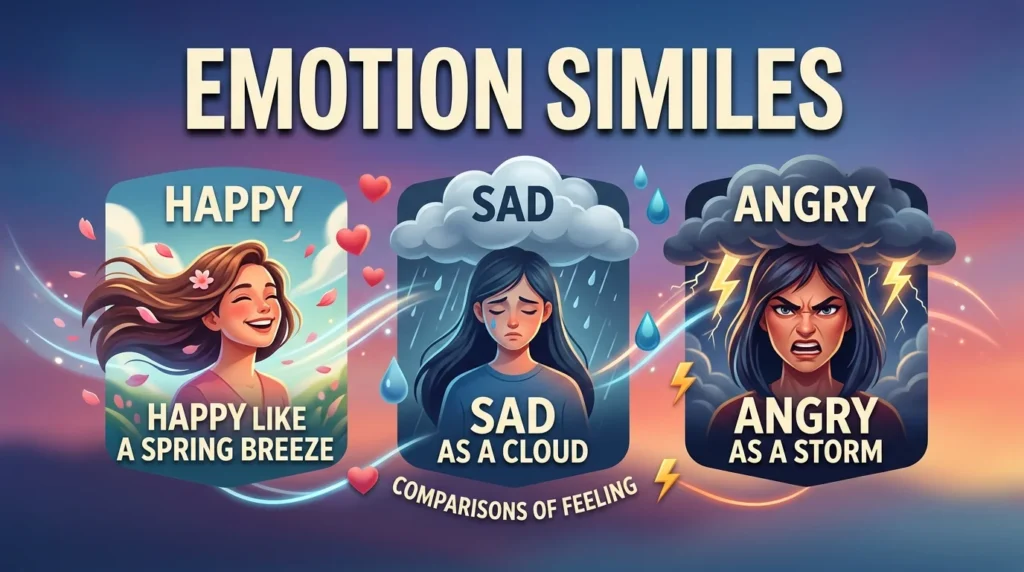
These comparisons help students describe emotions more clearly. For more examples, explore Similes for Being Happy.
Example
- As happy as a child at a carnival.
- Like sunshine after rain.
- As nervous as a mouse.
- Like a balloon ready to burst.
- As peaceful as a quiet garden.
Writing Tips and Common Mistakes
Useful Tips
- Always use like or as in a simile.
- Compare things that share a similar quality.
- Keep comparisons simple and meaningful.
- Avoid overusing similes in one paragraph.
- Choose familiar comparisons your readers understand.
- Match the simile with the tone of your writing.
- Read your sentence aloud to check if it sounds natural.
Common Mistakes to Avoid
- Comparing unrelated things without a shared quality.
- Using metaphors instead of similes.
- Incorrect: Time is a thief.
- Correct: Time is like a thief.
- Making comparisons too confusing.
- Repeating the same similes often.
- Using clichés too frequently instead of creating fresh comparisons.
30 Simile Examples For Students
As Bright as a Sunrise
Meaning: Very cheerful or full of hope.
Detailed Explanation: This simile describes someone or something that brings happiness and positive energy.
Tone: Positive
Examples
- Her smile was as bright as a sunrise.
- The classroom felt as bright as a sunrise after the decorations.
- His ideas were as bright as a sunrise.
As Quiet as Fresh Snow
Meaning: Extremely silent.
Detailed Explanation: It describes a place or moment with almost no sound.
Tone: Peaceful
Examples
- The library was as quiet as fresh snow.
- The room became as quiet as fresh snow.
- The forest stayed as quiet as fresh snow.
Like a Kite in the Wind
Meaning: Free and joyful.
Detailed Explanation: It describes someone enjoying freedom.
Tone: Cheerful
Examples
- She danced like a kite in the wind.
- The children ran like kites in the wind.
- He laughed like a kite in the wind.
As Busy as a School Hallway
Meaning: Very active.
Detailed Explanation: It describes a place filled with movement.
Tone: Lively
Examples
- The market was as busy as a school hallway.
- Our classroom became as busy as a school hallway.
- The fair looked as busy as a school hallway.
As Cool as a Morning Breeze
Meaning: Calm and relaxed.
Detailed Explanation: It shows peaceful behavior.
Tone: Calm
Examples
- She remained as cool as a morning breeze.
- He answered as cool as a morning breeze.
- The coach stayed as cool as a morning breeze.
Like Stars in the Sky
Meaning: Shining beautifully.
Detailed Explanation: It describes something sparkling or standing out.
Tone: Poetic
Examples
- Her eyes sparkled like stars in the sky.
- The lights shone like stars in the sky.
- The diamonds glittered like stars in the sky.
As Soft as a Feather Pillow
Meaning: Very soft.
Detailed Explanation: It emphasizes comfort.
Tone: Gentle
Examples
- The blanket felt as soft as a feather pillow.
- The kitten was as soft as a feather pillow.
- The clouds looked as soft as a feather pillow.
Like a Rocket Ready to Launch
Meaning: Full of energy.
Detailed Explanation: It describes excitement and speed.
Tone: Energetic
Examples
- He ran like a rocket, ready to launch.
- The team started like rockets, ready to launch.
- She answered like a rocket ready to launch.
As Sweet as Homemade Cookies
Meaning: Very kind.
Detailed Explanation: It describes a pleasant personality.
Tone: Friendly
Examples
- My teacher is as sweet as homemade cookies.
- Her voice sounded as sweet as homemade cookies.
- The little girl smiled as sweet as homemade cookies.
Like Rain After a Dry Day
Meaning: Very comforting.
Detailed Explanation: It describes something refreshing.
Tone: Hopeful
Examples
- His advice was like rain after a dry day.
- Good news came like rain after a dry day.
- Her kindness felt like rain after a dry day.
As Gentle as a Butterfly
Meaning: Very gentle.
Detailed Explanation: Describes soft actions.
Tone: Gentle
Examples
- She touched the flower as gently as a butterfly.
- His voice stayed as gentle as a butterfly.
- The nurse worked as gently as a butterfly.
As Fast as Flashing Lightning
Meaning: Extremely fast.
Detailed Explanation: Describes quick movement.
Tone: Dramatic
Examples
- The runner moved as fast as flashing lightning.
- The dog raced as fast as flashing lightning.
- She finished as fast as flashing lightning.
Like a Rainbow After Rain
Meaning: Bringing happiness.
Detailed Explanation: Shows hope after difficulties.
Tone: Inspirational
Examples
- Her success came like a rainbow after rain.
- Good news appeared like a rainbow after the rain.
- Friendship felt like a rainbow after the rain.
As Tall as a Pine Tree
Meaning: Very tall.
Detailed Explanation: Highlights impressive height.
Tone: Descriptive
Examples
- The building stood as tall as a pine tree.
- My cousin grew as tall as a pine tree.
- The statue looked as tall as a pine tree.
Like a Puzzle Coming Together
Meaning: Everything makes sense.
Detailed Explanation: Describes understanding.
Tone: Thoughtful
Examples
- The lesson came together like a puzzle.
- My ideas fit like a puzzle coming together.
- The project worked like a puzzle, coming together.
As Warm as Grandma’s Hug
Meaning: Loving and comforting.
Detailed Explanation: Shows affection.
Tone: Heartwarming
Examples
- Her welcome was as warm as Grandma’s hug.
- The blanket felt as warm as Grandma’s hug.
- His smile was as warm as Grandma’s hug.
Like a River That Never Stops
Meaning: Continuous.
Detailed Explanation: Shows steady progress.
Tone: Motivational
Examples
- She studied like a river that never stops.
- He worked like a river that never stops.
- Their kindness flowed like a river that never stops.
As Colorful as a Box of Crayons
Meaning: Full of variety.
Detailed Explanation: Describes colorful scenes.
Tone: Fun
Examples
- The festival looked as colorful as a box of crayons.
- Her drawing was as colorful as a box of crayons.
- The garden appeared as colorful as a box of crayons.
Like a Candle in Darkness
Meaning: Bringing hope.
Detailed Explanation: Represents guidance.
Tone: Inspirational
Examples
- Her words were like a candle in the darkness.
- His kindness shone like a candle in the darkness.
- The teacher became like a candle in the darkness.
As Sharp as Fresh Scissors
Meaning: Intelligent.
Detailed Explanation: Describes quick thinking.
Tone: Confident
Examples
- She is as sharp as fresh scissors.
- His answers were as sharp as fresh scissors.
- The student remained as sharp as fresh scissors.
As Gentle as Morning Rain
Meaning: Very gentle.
Detailed Explanation: Describes soft behavior.
Tone: Peaceful
Examples
- Her words were as gentle as morning rain.
- He spoke as gently as morning rain.
- The breeze felt as gentle as morning rain.
Like a Blooming Garden
Meaning: Full of life.
Detailed Explanation: Describes growth and beauty.
Tone: Positive
Examples
- The classroom looked like a blooming garden.
- Her imagination grew like a blooming garden.
- The event felt like a blooming garden.
As Clear as Crystal Water
Meaning: Easy to understand.
Detailed Explanation: Describes clarity.
Tone: Neutral
Examples
- His explanation was as clear as crystal water.
- The instructions stayed as clear as crystal water.
- Her handwriting looked as clear as crystal water.
Like Fresh Bread from the Oven
Meaning: Welcoming.
Detailed Explanation: Creates feelings of comfort.
Tone: Warm
Examples
- Their home felt like fresh bread from the oven.
- The classroom welcomed everyone like fresh bread from the oven.
- Her smile felt like fresh bread from the oven.
As Strong as an Oak Tree
Meaning: Very strong.
Detailed Explanation: Shows strength.
Tone: Powerful
Examples
- He stood as strong as an oak tree.
- Their friendship remained as strong as an oak tree.
- The bridge looked as strong as an oak tree.
Like a Spark in the Night
Meaning: Full of excitement.
Detailed Explanation: Describes energy.
Tone: Dramatic
Examples
- Her idea spread like a spark in the night.
- The performance arrived like a spark in the night.
- The celebration began like a spark in the night.
As Light as a Balloon
Meaning: Very light.
Detailed Explanation: Describes weightlessness.
Tone: Cheerful
Examples
- The bag felt as light as a balloon.
- Her steps became as light as a balloon.
- The pillow stayed as light as a balloon.
Like Waves on the Shore
Meaning: Continuous movement.
Detailed Explanation: Shows repetition.
Tone: Poetic
Examples
- The applause came like waves on the shore.
- Ideas arrived like waves on the shore.
- The laughter rolled like waves on the shore.
As Fresh as a Spring Morning
Meaning: New and energetic.
Detailed Explanation: Describes freshness.
Tone: Refreshing
Examples
- She looked as fresh as a spring morning.
- The classroom felt as fresh as a spring morning.
- His ideas stayed as fresh as a spring morning.
Like a Friendly Campfire

Meaning: Warm and welcoming.
Detailed Explanation: These comparisons help describe kindness and caring behavior. Students can make their writing more expressive by exploring Similes for Friendship and discovering creative ways to describe trust, support, and meaningful relationships.
Tone: Warm
Examples
- Her personality was like a friendly campfire.
- The meeting felt like a friendly campfire.
- His smile glowed like a friendly campfire.
Top 10 Simile Examples For Students
| Simile | Meaning | Tone |
| As Bright as a Sunrise | Cheerful and hopeful | Positive |
| Like a Kite in the Wind | Free and joyful | Cheerful |
| As Calm as a Morning Breeze | Relaxed and peaceful | Calm |
| Like Stars in the Sky | Bright and beautiful | Poetic |
| As Sweet as Homemade Cookies | Kind and pleasant | Friendly |
| Like a Rainbow After Rain | Hope after difficulty | Inspirational |
| As Warm as Grandma’s Hug | Loving and comforting | Heartwarming |
| As Strong as an Oak Tree | Powerful and dependable | Powerful |
| As Clear as Crystal Water | Easy to understand | Neutral |
| Like a Friendly Campfire | Warm and welcoming | Warm |
Students can strengthen their descriptive vocabulary by exploring Similes for Perseverance and learning how to express determination and resilience.
Conclusion
Learning how to use similes is a great way to make writing more vivid, creative, and engaging. These comparisons use “like” or “as” to connect two different things, helping readers picture ideas more clearly. Whether you’re writing a story, poem, essay, or classroom assignment, simile examples for students can provide inspiration for creating expressive sentences and communicating ideas effectively.
With regular practice, you can develop original comparisons inspired by everyday life, nature, emotions, and personal experiences. Exploring different types of similes can also expand your vocabulary and strengthen your descriptive writing skills. Over time, you’ll learn to turn ordinary sentences into memorable descriptions that capture readers’ attention and bring your ideas to life.
FAQs
What are Simile Examples For Students?
A simile is a figure of speech that compares two different things using the words “like” or “as.” These comparisons help describe people, places, objects, and feelings in a way that readers can easily imagine. By using familiar ideas to explain something, students can make their sentences more engaging, expressive, and descriptive.
Why are similes important for students?
Similes help students improve descriptive writing by making ideas easier to understand and more engaging. They encourage creativity, strengthen vocabulary, and help readers imagine scenes, emotions, and actions more vividly in stories, essays, and poems.
How can students identify a simile?
Students can identify a simile by looking for comparisons that use the words “like” or “as.” If a sentence compares two different things using either of these words to highlight a shared quality, it is usually a simile.
What is the difference between a simile and a metaphor?
A simile compares two things using “like” or “as,” while a metaphor makes a direct comparison without those words. For example, “She is as brave as a lion” is a simile, while “She is a lion” is a metaphor.
Can students create their own similes?
Yes, students should create their own similes to make writing more original. Think about a quality you want to describe, then compare it with something familiar that shares the same characteristic using “like” or “as.”
Where can students use similes?
Students can use similes in essays, stories, poems, speeches, journal entries, classroom assignments, and creative writing projects. They add detail and make descriptions more memorable without making the writing difficult to understand.
What are common mistakes when writing similes?
Common mistakes include comparing unrelated things, forgetting to use “like” or “as,” overusing the same similes, or creating comparisons that confuse readers. Clear, meaningful, and relevant comparisons always produce stronger writing.
Are similes suitable for formal writing?
Yes, similes can be used in formal writing when they support the message and fit the context. They work especially well in speeches, descriptive essays, and presentations where vivid language helps explain ideas effectively.
How do similes improve creative writing?
Similes help readers imagine characters, settings, and emotions more clearly. They add color, personality, and emotion to writing, making stories and poems more engaging while helping writers express ideas in fresh and memorable ways.
How can students practice writing better similes?
Students can practice by observing everyday objects, nature, people, and emotions, then creating simple comparisons using “like” or “as.” Reading books, writing regularly, and experimenting with new ideas will gradually improve their simile-writing skills.