
Many English learners confuse advice vs. advise because they look and sound very similar. However, they have different grammatical roles and are used in different situations. Understanding the difference between advice ” and ” advise will help you write and speak English more accurately and avoid one of the most common grammar mistakes.
Advice vs. Advise: Comparison Overview
Both advice and advise relate to giving recommendations, guidance, or suggestions. The key difference is that advice is a noun, while advise is a verb. In simple terms, advice is the suggestion itself, and advising is the action of giving that suggestion.
| Feature | Advice | Advise |
| Part of Speech | Noun | Verb |
| Meaning | A suggestion or recommendation | To give a suggestion or recommendation |
| Usage | Refers to information or guidance | Refers to the act of giving guidance |
| Example | Thank you for your advice. | I advise you to study harder. |
Definition of Advice
Advice is a noun that means a recommendation, suggestion, or opinion given to help someone make a decision or solve a problem.
It represents the guidance itself rather than the action of giving it.
Key Points
- It is a noun.
- It cannot be used as an action word.
- It is usually uncountable.
- It often follows verbs like give, offer, ask for, or take.
Examples:
- She gave me useful advice.
- I need your advice before making a decision.
- His advice helped me pass the exam.
Definition of Advise
Advise is a verb that means to recommend, suggest, or guide someone.
It describes the action of giving advice.
Key Points
- It is a verb.
- It shows an action.
- It is commonly followed by a person or an infinitive.
Examples:
- I advise you to wear a helmet.
- The doctor advised me to exercise regularly.
- They advised us against traveling at night.
Main Differences Between Advice vs. Advise
| Aspect | Advice | Advise |
| Grammar | Noun | Verb |
| Purpose | Refers to guidance | Refers to giving guidance |
| Answers | What? | What action? |
| Sentence Role | Object or subject | Main verb |
| Example | Your advice was helpful. | I advise you to listen carefully. |
Key Differences
- Advice is something you receive or give.
- Advice is the action of giving recommendations.
- Advice never functions as a verb.
- Advise never functions as a noun.
Pronunciation Difference
Although they look similar, their pronunciation is slightly different.
| Word | Pronunciation |
| Advice | ad-VICE (/ədˈvaɪs/) |
| Advise | ad-VIZE (/ədˈvaɪz/) |
A helpful trick is to remember:
- Advice ends with an “s” sound.
- Advice ends with a “z” sound.
Common Words Used with Advice vs. Advise
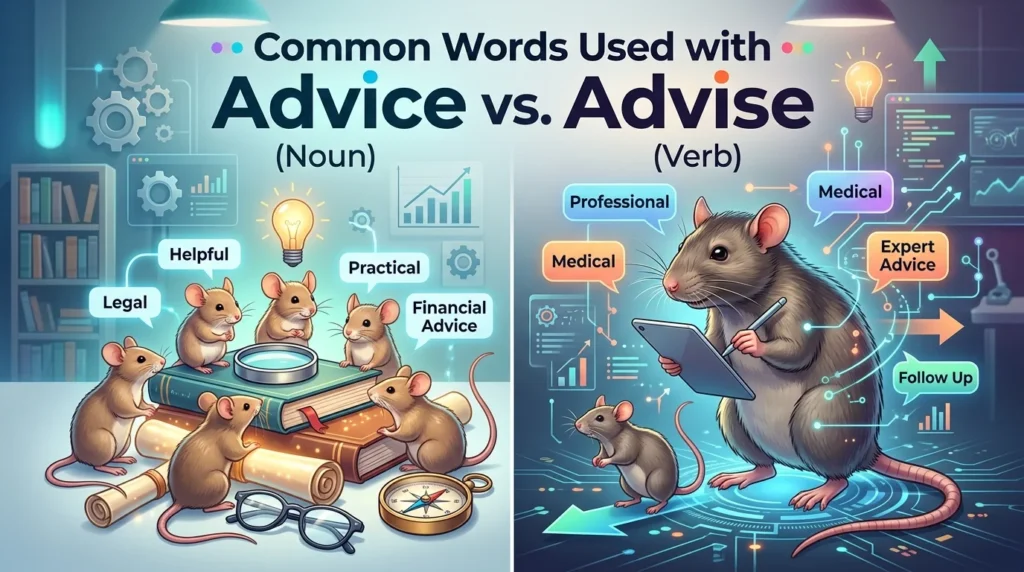
Words Commonly Used with Advice
- Give advice
- Take advice
- Ask for advice
- Good advice
- Helpful advice
- Professional advice
- Financial advice
- Medical advice
Words Commonly Used with Advice
- Advise someone
- Strongly advise
- Highly advise (less common; “strongly recommend” is often preferred)
- Advise against
- Advise to wait
- Advise customers
Advice vs. Advise: Grammar Guide
Advice is a noun, while advise is a verb.
Grammar Summary
| Word | Grammar Type |
| Advice | Noun |
| Advise | Verb |
How Each Term Is Used in Sentences
Advice Pattern
- Give + advice
- Need + advice
- Ask for + advice
- Take + advice
Examples:
- Please give me some advice.
- We asked for legal advice.
- I followed your advice.
Advise Pattern
- Advise + someone
- Advise + someone + to + verb
- Advise against + noun/verb-ing
Examples:
- I advise students to revise daily.
- She advised us against driving in the storm.
- The lawyer advised his client to wait.
Common Mistakes Learners Make
Incorrect: She advised me yesterday.
Correct: She advised me yesterday.
Incorrect: He gave me much advice.
Correct: He gave me a lot of advice.
Incorrect: Can you advise me?
Correct: Can you advise me?
Incorrect: My teacher gave me advice.
Correct: My teacher gave me some advice.
Simple Rules to Remember
- Advice = Thing (noun).
- Advise = Action (verb).
- If you can replace it with a suggestion, use advice.
- If you can replace it with recommend, use advise.
Quick Tips for Writing and Speaking
- Think of advice as information.
- Think of advice as an action.
- Never write advice in standard English.
- Use advice whenever someone is performing the act of recommending.
When to Use Each One
Use Advice When
- Talking about recommendations.
- Referring to the guidance received.
- Discussing opinions or suggestions.
Examples:
- I appreciate your advice.
- Good financial advice saves money.
- Her advice changed my career.
Use Advice When
- Giving recommendations.
- Suggesting an action.
- Warning someone.
Examples:
- I advise you to save money.
- Teachers advise students every day.
- Experts advise wearing sunscreen.
When NOT to Use Each One
Do not use advice when describing an action.
Incorrect:
- I advise you to leave.
Correct:
- I advise you to leave.
Do not use advise when referring to a suggestion itself.
Incorrect:
- Thank you for your advice.
Correct:
- Thank you for your advice.
Which One to Use (Decision Guide)
Ask yourself these questions:
Are you talking about a suggestion?
→ Use advice.
Are you talking about giving a suggestion?
→ Use advice.
Quick Decision Table
| Question | Correct Word |
| Is it a noun? | Advice |
| Is it a verb? | Advise |
| Referring to guidance? | Advice |
| Giving guidance? | Advise |
Real-World Practical Examples
Advice Examples
- My teacher gave me valuable advice before the exam.
- Good financial advice can prevent debt.
- The doctor offered health advice during the checkup.
- I followed my manager’s advice at work.
- Parents often advise about life decisions.
Advise Examples
- Teachers advise students to read every day.
- Scientists advise reducing plastic waste.
- The doctor advised me to rest for a week.
- My lawyer advised me to keep the documents safe.
- Technology experts advise updating software regularly.
Self-Assessment (Fill in the Blanks)
- I will use ______ when referring to a helpful suggestion. The correct word is ______ because it is a noun.
- I will use ______ when talking about giving recommendations. The correct word is ______ because it is a verb.
- My teacher gave me useful ______. The correct word is ______ because it names guidance.
- Doctors often ______ patients to eat healthy food. The correct word is ______ because it shows an action.
- Thank you for your ______. The correct word is ______ because it refers to guidance received.
- I ______ you to save your work regularly. The correct word is ______ because it describes giving a recommendation.
- She asked for career ______. The correct word is ______ because it is a thing.
- Experts ______ wearing seat belts. The correct word is ______ because it is an action.
- His ______ improved my writing. The correct word is ______ because it names a suggestion.
- I strongly ______ arriving early. The correct word is ______ because it is a verb.
- Good ______ can improve your decisions. The correct word is ______ because it refers to recommendations.
- Parents often ______ their children about safety. The correct word is ______ because they act.
- We need professional ______ before investing. The correct word is ______ because it is guidance.
- The coach ______ the players to practice daily. The correct word is ______ because it expresses an action.
- Can you give me some ______? The correct word is ______ because it is a noun.
- I would ______ checking the weather first. The correct word is ______ because it is a verb.
- Her ______ helped us solve the problem. The correct word is ______ because it is a thing.
- Lawyers often ______ clients carefully. The correct word is ______ because it is an action.
- Always listen to good ______. The correct word is ______ because it means guidance.
- Teachers ______ students before examinations. The correct word is ______ because it is the act of giving recommendations.
Answers
- advice
- advise
- advice
- advise
- advice
- advise
- advice
- advise
- advice
- advise
- advice
- advise
- advice
- advise
- advice
- advise
- advice
- advise
- advice
- advise
Advice vs. Advise: Final Verdict
The difference between advice and advise is simple once you remember their grammatical roles. Advice is a noun that refers to the guidance, recommendation, or suggestion itself, while advise is a verb that means to give that guidance or recommendation. If you are talking about the information someone gives, choose advice. If you are describing the action of recommending or guiding someone, choose advise. Keeping this simple noun-versus-verb distinction in mind will help you use both words correctly in speaking and writing, making your English clearer, more natural, and grammatically accurate.
Conclusion
Understanding the difference between advice vs. advise is much easier once you remember that advice is a noun and advise is a verb. While these two words look almost identical, they play very different roles in English grammar. Advice refers to the guidance or recommendation someone gives, whereas advise means the act of giving that guidance. Knowing when to use each word will improve your writing, speaking, and overall confidence in English.
Whether you’re writing an email, completing schoolwork, communicating in the workplace, or having a casual conversation, choosing the correct word helps your message sound clear and professional. A simple way to remember the difference is that you give advice, but advise someone. With regular practice and by paying attention to sentence structure, you’ll quickly master this commonly confused word pair and avoid mistakes in everyday communication.
FAQs
What is the difference between advice and advise?
The main difference is their grammatical function. Advice is a noun that means a suggestion or recommendation, while advise is a verb that means to give a suggestion or recommendation. One refers to the guidance itself, and the other refers to the action of giving it.
Is advice a noun or a verb?
Advice is always a noun. It refers to guidance, suggestions, or recommendations given to someone. It cannot be used as an action word in a sentence. If you need a verb, the correct choice is advise.
Is advise a noun or a verb?
Advise is a verb. It describes the action of giving guidance, suggestions, or recommendations to another person. It is commonly followed by a person and often an infinitive, such as “to study” or “to wait.”
Can I say “advice” in English?
In standard English, advice is an uncountable noun, so advices is generally incorrect. Instead, say some advice, a piece of advice, or a bit of advice when referring to individual suggestions.
Which word should I use after “give”?
After the verb give, you should use advice because it is a noun. For example, “She gave me good advice” is correct. Using advise after give would be grammatically incorrect.
Which word should I use before “someone to do something”?
When you are talking about recommending an action to someone, use advice. For example, “I advise you to read every day” is correct because advise expresses the action of giving a recommendation.
Why do people confuse advice and advise?
People often confuse these words because they have similar spelling, pronunciation, and meaning. However, remembering that advice is a noun and advise is a verb makes it much easier to choose the correct word in any sentence.
How can I remember the difference between advice and advise?
A simple trick is to remember that advice is something you receive or give, while advise is something you do. If the sentence needs an action, choose advise. If it needs a thing or an idea, choose advice.
Are advice and advise used in formal writing?
Yes, both words are common in formal and informal English. They frequently appear in academic writing, business communication, professional emails, reports, articles, and everyday conversations, provided they are used according to their correct grammatical roles.
Can advice and advise be used in the same sentence?
Yes. Since one is a noun and the other is a verb, they can appear together naturally. For example, “I advise you to follow your teacher’s advice” is grammatically correct and clearly demonstrates the difference between the two words.