
Many English learners confuse affect vs. effect because they look and sound similar. However, they have different meanings and grammatical roles. Understanding the difference between affect ” and ” effect will help you write more accurately, speak with confidence, and avoid one of the most common mistakes in English grammar.
Affect vs. Effect: Comparison Overview
Although affect and effect are closely related, they are not interchangeable in most situations.
- Affect is usually a verb that means to influence or change something.
- An effect is usually a noun that means the result or outcome of a change.
In simple terms:
- Affect = Action (Verb)
- Effect = Result (Noun)
Understanding this relationship makes it much easier to choose the correct word.
| Feature | Affect | Effect |
| Part of Speech | Usually a verb | Usually a noun |
| Meaning | To influence or change | A result or outcome |
| Question it answers | What changed something? | What happened because of it? |
| Example | Lack of sleep affects mood. | Lack of sleep has a negative effect. |
Definition of Affect
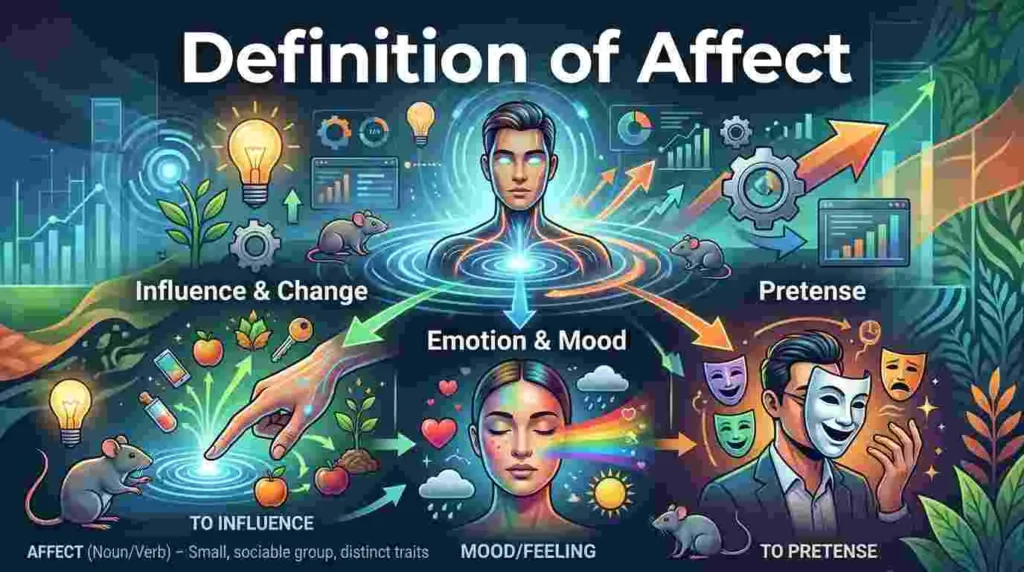
Affect is most commonly used as a verb. It means to influence, change, or have an impact on someone or something.
Whenever one thing changes another, the word affect is usually the correct choice.
Examples
- The weather can affect travel plans.
- Stress affects your health.
- Poor lighting affects productivity.
- Exercise positively affects mental health.
- Inflation affects consumer spending.
Definition of Effect
Effect is most commonly used as a noun. It refers to the result, consequence, or outcome produced by a cause.
Think of effect as what happens after something else occurs.
Examples
- The medicine had an immediate effect.
- The new law had a positive effect.
- Pollution has harmful effects on wildlife.
- The speech had a powerful effect on the audience.
- Good communication creates a positive effect.
Main Differences Between Affect vs. Effect
Although these words are related, they serve different purposes in grammar.
| Aspect | Affect | Effect |
| Meaning | To influence | Result of an influence |
| Grammar | Verb | Noun |
| Focus | The action | The outcome |
| Sentence Role | Shows what something does | Shows what happened |
| Easy Memory Tip | Affect = Action | Effect = End Result |
Key Difference
- If something changes another thing, use the effect.
- If you’re talking about the result of that change, use effect.
Example Pair
- The cold weather affected the crops.
- The effect of the cold weather was a poor harvest.
Affect vs Effect Comparison Table
| Situation | Correct Word | Example |
| Influence someone | Affect | Noise affects concentration. |
| Describe a result | Effect | The effect was noticeable. |
| Change behavior | Affect | Rewards affect motivation. |
| Talk about an outcome | Effect | The new policy had little effect. |
| Explain consequences | Effect | The effects lasted for months. |
Affect vs. Effect: Grammar Guide
How Each Term Is Used in Sentences
Affect
Pattern:
Subject + affect + object
Examples:
- Exercise affects energy.
- Rain affects driving conditions.
- Music affects emotions.
Effect
Pattern:
Subject + have/cause + effect
Examples:
- The treatment had a positive effect.
- Pollution causes harmful effects.
- The change produced a noticeable effect.
Common Mistakes Learners Make
Many learners mistakenly write:
❌ The weather had a bad effect.
✅ The weather had a bad effect.
Another common mistake:
❌ Stress affects sleep.
✅ Stress affects sleep.
Remember that affect usually acts, while effect names the result.
Affect vs. Effect: Simple Rules to Remember
- Affect = Action
- Effect = End Result
- If you can replace the word with influence, choose affect.
- If you can replace it with a result, choose effect.
Quick Tips for Writing and Speaking
- Ask yourself whether you’re describing an action or a result.
- If it’s changing something, use affect.
- If it’s the outcome, use effect.
- Proofread carefully because spellcheck often won’t catch this mistake.
- Practice with everyday examples until the pattern feels natural.
Affect vs. Effect: When to Use Each One
Use affect when:
- Talking about influence
- Describing change
- Explaining causes
- Discussing impacts
- Writing scientific reports
Use effect when:
- Talking about results
- Explaining consequences
- Describing outcomes
- Reporting findings
- Discussing final impacts
When NOT to Use Each One
Do not use affect when referring to the result of something.
Incorrect:
- The medicine had a good effect.
Correct:
- The medicine had a good effect.
Do not use effect when describing an action.
Incorrect:
- The weather affected my mood.
Correct:
- The weather affected my mood.
(Note: “effect” can occasionally be used as a verb meaning “to bring about,” but this is uncommon and more formal.)
Which One to Use (Decision Guide)
Use this simple guide whenever you’re unsure.
Choose Affect if:
- You’re describing influence.
- The word is acting as a verb.
- Something is changing something else.
Choose Effect if:
- You’re describing the outcome.
- The word is a noun.
- You’re talking about a result or consequence.
Easy Formula
Cause → Affect → Effect
Example:
Stress → affects → health → producing a negative effect.
Affect vs. Effect: Real-World Practical Examples
Affect Examples
- Regular exercise affects overall health.
- Heavy traffic affects travel time.
- Social media affects communication habits.
- Rising prices affect family budgets.
- Good teachers affect students’ confidence.
Effect Examples
- The medicine had a calming effect.
- Advertising has a strong effect on sales.
- Climate change has serious effects on ecosystems.
- The announcement had an immediate effect on stock prices.
- Reading daily has a positive effect on vocabulary.
Self-Assessment (Fill in the Blanks)
- I will use ______ when referring to influencing someone’s mood. The correct word is ______ because it describes an action.
- I will use ______ when referring to the result of medicine. The correct word is ______ because it names an outcome.
- I will use ______ when discussing how rain changes driving conditions. The correct word is ______ because it describes influence.
- I will use ______ when talking about the outcome of a new policy. The correct word is ______ because it means result.
- I will use ______ when explaining how stress changes sleep. The correct word is ______ because it is a verb.
- I will use ______ when discussing the result of pollution. The correct word is ______ because it names a consequence.
- I will use ______ when describing how music changes emotions. The correct word is ______ because it shows influence.
- I will use ______ when talking about the outcome of education. The correct word is ______ because it refers to a result.
- I will use ______ when explaining how technology changes communication. The correct word is ______ because it is an action.
- I will use ______ when referring to the outcome of hard work. The correct word is ______ because it is a noun.
- I will use ______ when discussing how weather changes crops. The correct word is ______ because it describes influence.
- I will use ______ when referring to the result of exercise. The correct word is ______ because it means outcome.
- I will use ______ when explaining how advertising changes buying habits. The correct word is ______ because it is a verb.
- I will use ______ when discussing the result of training. The correct word is ______ because it refers to the outcome.
- I will use ______ when describing how noise changes concentration. The correct word is ______ because it shows influence.
- I will use ______ when talking about the consequence of a decision. The correct word is ______ because it means result.
- I will use ______ when explaining how sunlight changes plant growth. The correct word is ______ because it is an action.
- I will use ______ when discussing the result of better planning. The correct word is ______ because it names an outcome.
- I will use ______ when describing how inflation changes prices. The correct word is ______ because it is a verb.
- I will use ______ when referring to the outcome of a scientific experiment. The correct word is ______ because it is a noun.
Answers
- Affect, Affect
- Effect, Effect
- Affect, Affect
- Effect, Effect
- Affect, Affect
- Effect, Effect
- Affect, Affect
- Effect, Effect
- Affect, Affect
- Effect, Effect
- Affect, Affect
- Effect, Effect
- Affect, Affect
- Effect, Effect
- Affect, Affect
- Effect, Effect
- Affect, Affect
- Effect, Effect
- Affect, Affect
- Effect, Effect
Affect vs. Effect: Final Verdict
Understanding affect vs. effect becomes much easier once you remember their basic roles. In most cases, affect is a verb that means to influence or change something, while effect is a noun that means the result or outcome of that change. This simple distinction will help you avoid one of the most common grammar mistakes in English. Whenever you’re unsure, ask yourself whether you’re describing an action or a result. If it’s an action, choose affect. If it’s the outcome, choose effect. With regular practice and real-world examples, you’ll soon be able to use both words naturally and confidently in speaking, writing, academic work, and professional communication.
Conclusion
Mastering the difference between affect ” vs. ” effect is an important step toward improving your English grammar and writing skills. Although these two words are closely connected, remembering that affect usually means to influence and effect usually means the result or outcome makes choosing the correct word much easier.
Whether you’re writing an academic paper, a business email, a blog post, or simply having a conversation, using these terms correctly helps your communication sound more natural and professional. The more you practice recognizing whether you’re describing an action or a result, the more confident you’ll become. By understanding their meanings, grammar, and real-world usage, you’ll avoid one of the most common mistakes in English. Keep this simple rule in mind whenever you’re unsure, and soon using affect and effect correctly will become second nature in both your writing and everyday speech.
FAQs
What is the main difference between affect and effect?
The main difference is that affect is usually a verb meaning to influence or change something, while effect is usually a noun meaning the result or consequence of that influence. In most everyday writing, this distinction helps you choose the correct word quickly and accurately.
Is affect always a verb?
No. Although affect is most commonly used as a verb, it can also be a noun in psychology, where it refers to a person’s emotional expression. However, this usage is uncommon, so most learners only need to remember that affect usually functions as a verb.
Is effect always a noun?
Not always. Effect is generally used as a noun meaning result or outcome. In formal English, it can also be used as a verb meaning to bring about or accomplish, but this usage is much less common than its noun form.
How can I remember the difference between affect and effect?
A simple memory trick is that Affect equals Action and Effect equals result. If something is influencing another thing, use affect. If you’re referring to the outcome or consequence of that influence, use effect.
Which word is correct in the sentence “The weather ___ my mood”?
The correct word is affected because the weather is influencing your mood. Since the sentence describes an action that changes something, affect is the appropriate choice rather than effect.
Which word is correct in the sentence “The medicine had a positive ___”?
The correct word is effect because the sentence refers to the result produced by the medicine. Since you’re describing an outcome rather than an action, effect is the correct grammatical choice.
Why do people confuse affect and effect?
People often confuse these words because they are spelled similarly, sound alike, and are closely related in meaning. One refers to causing change, while the other refers to the result of that change, making them easy to mix up without practice.
Can affect and effect be used interchangeably?
No. In most situations, they cannot be used interchangeably because they have different grammatical roles and meanings. Replacing one with the other often creates a grammatical error or changes the meaning of the sentence.
Are affect and effect commonly used in academic writing?
Yes. Both words appear frequently in academic, scientific, and professional writing. Researchers often describe how one variable affects another and then discuss the effects observed in the results or conclusions.
How can I improve my use of affect and effect?
The best way is to practice writing sentences using both words in different contexts. Reading English articles, proofreading your work, and remembering that affect usually shows an action while effect names a result will gradually make correct usage feel natural.