
Many English learners confuse allusion vs. illusion because the words look and sound similar. However, they have completely different meanings and are used in different situations. Understanding the difference between allusion and illusion will help you write, speak, and understand English more accurately while avoiding one of the most common vocabulary mistakes.
Allusion vs. Illusion: Comparison Overview
Although allusion and illusion differ by only one letter, they are unrelated in meaning.
- Allusion refers to an indirect reference to someone, something, or an event.
- Illusion refers to something that deceives the senses or creates a false impression.
Knowing whether you are talking about a reference or a false appearance makes choosing the correct word easy.
| Feature | Allusion | Illusion |
| Meaning | An indirect reference | A false appearance or deceptive perception |
| Part of Speech | Noun | Noun |
| Related To | Literature, speech, writing | Vision, psychology, magic, perception |
| Purpose | To hint at something | To create or describe something misleading |
| Example | An allusion to Greek mythology | An optical illusion |
Definition of Allusion
An allusion is an indirect or brief reference to a well-known person, place, event, story, book, or idea. Instead of explaining everything, the speaker or writer expects the audience to recognize the reference.
Allusions are common in literature, speeches, movies, advertisements, and everyday conversations. They add meaning without giving lengthy explanations.
Examples:
- Her speech contained an allusion to Shakespeare.
- The novel makes an allusion to World War II.
- His comment was an allusion to their earlier disagreement.
Definition of Illusion
An illusion is a false idea, misleading appearance, or something that tricks your senses into believing something that is not actually true.
Illusions can be visual, mental, emotional, or psychological. They are often discussed in science, psychology, art, and magic.
Examples:
- The magician created the illusion of floating.
- The picture creates an optical illusion.
- Success without hard work is often an illusion.
Main Differences Between Allusion vs. Illusion
The biggest difference is what each word represents.
| Aspect | Allusion | Illusion |
| Basic Meaning | An indirect reference | A false impression |
| Used In | Literature, speeches, writing | Science, psychology, art, magic |
| Focus | Mentioning something indirectly | Misleading the senses or mind |
| Audience | Expected to recognize the reference | Experiences something deceptive |
| Memory Tip | Allusion = “A” for “Reference to Another thing” | Illusion = “I” for “Imaginary appearance” |
Key Differences
- Allusion points to something without naming it directly.
- Illusion creates something that seems real but isn’t.
- Writers use allusions to enrich meaning.
- Magicians and artists often use illusions to entertain.
- One deals with references, while the other deals with deception or perception.
Allusion vs. Illusion in Literature and Everyday Life
Both words frequently appear in books and conversations, but for different reasons.
Allusion in Literature
Authors use allusions to connect readers with famous stories, historical events, myths, or religious texts.
Example:
“He met his Waterloo.”
This is an allusion to Napoleon’s final defeat.
Illusion in Everyday Life
Illusions appear whenever something seems different from reality.
Examples include:
- Optical illusions
- Magic tricks
- Mirages
- False beliefs
Comparison Table: Allusion vs. Illusion
| Category | Allusion | Illusion |
| Pronunciation | uh-LOO-zhun | ih-LOO-zhun |
| Type | Noun | Noun |
| Related Words | Allude, reference | Illusory, deceptive |
| Common Fields | Literature, education | Science, psychology, art |
| Easy Meaning | Indirect mention | False appearance |
Allusion vs. Illusion: Grammar Guide
Both allusion and illusion are countable nouns.
How each term is used in sentences
Allusion
Pattern:
Subject + makes/contains + an allusion + to + noun
Examples:
- The author alluded to Greek mythology.
- Her speech contained an allusion to history.
- The poem includes an allusion to the Bible.
Illusion
Pattern:
Subject + creates/is + an illusion + of + noun
Examples:
- The mirror creates an illusion of space.
- The magician created the illusion of disappearing.
- The design gives the illusion of movement.
Common mistakes learners make
- Using illusion when talking about references.
- Using allusion when describing magic tricks.
- Thinking both words have the same meaning because they sound alike.
- Forgetting that both words are nouns.
- Confusing allude (verb) with illusion (noun).
Simple rules to remember
- Allusion = A = A Reference.
- Illusion = I = Imaginary Appearance.
- If you’re hinting at another story, use allusion.
- If something isn’t actually real, use illusion.
- Ask yourself whether you’re referring to an idea or a false appearance.
Quick tips for writing and speaking
- Use allusion in essays, novels, speeches, and literary analysis.
- Use illusion when discussing vision, psychology, or magic.
- Remember that context usually reveals the correct choice.
- Read the sentence aloud to check whether you’re describing a reference or a deception.
- Practice using both words in different contexts.
When to Use Each One
Use Allusion When
- Referring indirectly to famous people or events.
- Writing essays or literature reviews.
- Analyzing poems and novels.
- Giving speeches.
- Creating symbolic writing.
Use Illusion When
- Talking about magic.
- Describing optical tricks.
- Discussing psychology.
- Explaining visual effects.
- Referring to false beliefs or appearances.
When NOT to Use Each One
Do not use allusion:
- For optical tricks.
- For visual deception.
- For false appearances.
- For magic performances.
- For psychological perception.
Do not use illusion:
- When making literary references.
- When mentioning famous stories indirectly.
- In place of “reference.”
- For symbolic hints in writing.
- To describe indirect historical mentions.
Which One to Use (Decision Guide)
Ask yourself these simple questions.
Are you indirectly referring to something famous?
➡ Use allusion.
Are you describing something that only appears to be real?
➡ Use illusion.
Is it about literature or writing?
➡ Usually allusion.
Is it about vision, magic, or deception?
➡ Usually illusion.
Real-World Practical Examples
Allusion Examples
- The teacher noticed an allusion to Greek mythology in the essay.
- His speech included an allusion to a famous historical leader.
- The advertisement made an allusion to a classic movie.
- The novel contains several allusions to ancient legends.
- During the meeting, she made an allusion to last year’s business failure.
Illusion Examples
- The scientist explained how optical illusions fool the brain.
- The magician created the illusion of walking through a wall.
- The room’s mirrors give the illusion of extra space.
- Social media sometimes creates the illusion of a perfect life.
- The software creates the illusion of three-dimensional movement.
Self-Assessment (Fill in the Blanks)
- I will use ________ when referring to a famous story indirectly. The correct word is ________ because it is an indirect reference.
- I will use ________ when discussing a magic trick. The correct word is ________ because it describes a false appearance.
- I will use ________ when analyzing a poem. The correct word is ________ because poems often contain indirect references.
- I will use ________ when talking about a mirage. The correct word is ________ because a mirage deceives the eyes.
- I will use ________ when discussing Shakespeare references. The correct word is ________ because it refers indirectly to another work.
- I will use ________ when describing visual deception. The correct word is ________ because it tricks perception.
- I will use ________ when writing literary criticism. The correct word is ________ because literary works often include references.
- I will use ________ when talking about an optical trick. The correct word is ________ because it concerns misleading vision.
- I will use ________ when referring to mythology in an essay. The correct word is ________ because it indirectly mentions another story.
- I will use ________ when discussing a magician’s performance. The correct word is ________ because it creates false appearances.
- I will use ________ when mentioning historical events indirectly. The correct word is ________ because it hints at another event.
- I will use ________ when discussing false beliefs. The correct word is ________ because it means something misleading.
- I will use ________ when reading symbolic novels. The correct word is ________ because symbolic writing often contains indirect references.
- I will use ________ when explaining a mirror effect. The correct word is ________ because mirrors can create false appearances.
- I will use ________ when identifying references in speeches. The correct word is ________ because speeches may hint at famous events.
- I will use ________ when discussing visual perception. The correct word is ________ because perception can be deceived.
- I will use ________ when talking about classic literature references. The correct word is ________ because literature often uses indirect references.
- I will use ________ when describing impossible visual effects. The correct word is ________ because they are deceptive.
- I will use ________ when studying symbolism in novels. The correct word is ________ because symbolism often includes indirect references.
- I will use ________ when discussing something that only seems real. The correct word is ________ because it describes a false impression.
Answers
- Allusion
- Illusion
- Allusion
- Illusion
- Allusion
- Illusion
- Allusion
- Illusion
- Allusion
- Illusion
- Allusion
- Illusion
- Allusion
- Illusion
- Allusion
- Illusion
- Allusion
- Illusion
- Allusion
- Illusion
Allusion vs. Illusion: Final Verdict
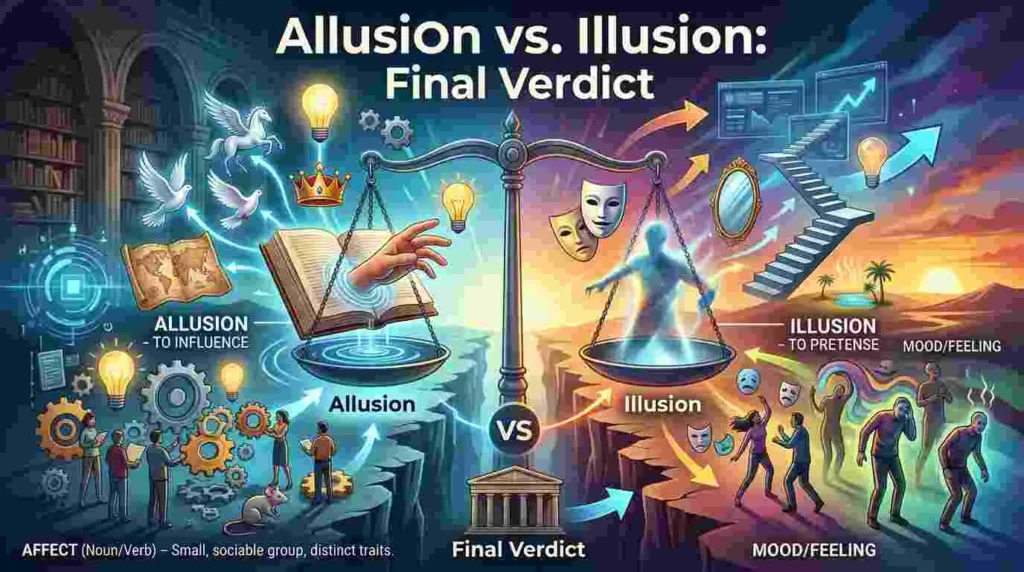
Although allusion vs. illusion look and sound alike, they describe completely different ideas. Allusion is an indirect reference to a person, place, event, or work, making it especially useful in literature, speeches, and writing. Illusion, on the other hand, refers to a false appearance or misleading perception, commonly used in science, psychology, art, and magic. Remember this simple trick: allusion points to something else, while illusion makes something appear different from reality. Once you understand this distinction, choosing the correct word becomes much easier, helping you communicate more clearly and confidently in both writing and conversation.
Conclusion
Understanding the difference between allusion vs. illusion can greatly improve your English vocabulary, writing, and communication skills. While these two words may look and sound alike, they serve completely different purposes. An allusion is an indirect reference to a person, event, or work, often used in literature, speeches, and everyday writing to add deeper meaning. An illusion, on the other hand, refers to a false appearance or something that deceives the senses or mind.
Recognizing this distinction helps you avoid common mistakes and use each word confidently in the right context. Whether you are a student, writer, teacher, or English learner, mastering these commonly confused words will make your language more accurate and expressive. The next time you encounter allusion or illusion, simply ask yourself whether the sentence is referring to something indirectly or describing something that only appears to be real. That simple check will help you choose the correct word every time.
FAQs
What is the main difference between allusion and illusion?
The main difference is that allusion is an indirect reference to a well-known person, event, or work, while illusion is a false appearance or something that tricks the senses. One relates to references in language, and the other relates to deception or perception.
Is allusion used only in literature?
No. Although allusion is very common in literature, it is also used in speeches, conversations, journalism, advertising, and movies. People often make allusions to famous events, historical figures, or popular culture to communicate ideas more effectively.
What does illusion mean in simple words?
An illusion is something that appears to be real but is not. It can be a visual trick, a misleading belief, or a false impression. Illusions are commonly discussed in psychology, science, magic, and art because they involve perception rather than reality.
Are allusion and illusion the same part of speech?
Yes. Both allusion and illusion are nouns. However, they have different meanings and are used in different contexts. Even though they share the same grammatical category, they should never be used interchangeably.
How can I remember the difference between allusion and illusion?
A simple memory trick is to remember that allusion starts with A, which can remind you of another reference, while illusion begins with I, which can remind you of an imaginary appearance. This makes it easier to choose the correct word.
Can an illusion be something other than a visual trick?
Yes. An illusion can also describe a false belief, unrealistic expectation, or misleading idea. For example, someone may live under the illusion that success comes without effort. The word is not limited to optical or visual effects.
Why do writers use allusions?
Writers use allusions to add depth, meaning, and cultural connections to their work. By referring indirectly to familiar stories, historical events, or famous people, they encourage readers to make connections without explaining every detail.
Is an optical illusion the same as an allusion?
No. An optical illusion tricks your eyes into seeing something that is not actually there or appears differently from reality. An allusion has nothing to do with vision. Instead, it is a literary or conversational reference to something well-known.
Can allusion and illusion appear in the same sentence?
Yes. For example: The author’s allusion to a famous magician enhanced the story, while the stage performance created an illusion that amazed the audience. Each word keeps its own distinct meaning within the sentence.
Which word should I use in everyday writing?
Choose allusion when you are indirectly referring to a famous person, place, event, or work. Choose illusion when describing something deceptive, unreal, or misleading. Thinking about whether the sentence involves a reference or a false appearance will help you decide.