
Many English learners get confused between ” even though “ vs. even though because they look almost identical. However, only one of them is considered correct in standard English. Understanding the difference will help you write more accurately, avoid common grammar mistakes, and communicate more confidently in both formal and informal situations.
Even though vs. Even Though: Comparison Overview
Although, even though,h and even though appear similar, but they are not equally correct in English grammar. Even though is a misspelling and is not accepted in standard English.
- Even though is the correct two-word conjunction used to introduce a contrast or unexpected result.
Whether you’re writing essays, emails, reports, or casual messages, knowing the correct form is essential.
| Feature | Eventhough | Even Though |
| Correct spelling | ❌ No | ✅ Yes |
| Number of words | One | Two |
| Accepted in formal writing | ❌ No | ✅ Yes |
| Grammar status | Misspelling | Subordinating conjunction |
| Used to show contrast | ❌ Incorrect | ✅ Correct |
Definition of Eventhough
Even though is an incorrect spelling created by combining the words even and though into one word. It is not recognized in standard English dictionaries or grammar rules.
Many learners accidentally write ” even though “ because it sounds like one word when spoken. However, it should never be used in formal or academic writing.
Core purpose:
- None, because it is not a valid English word.
Definition of Even Though
Even though is a subordinating conjunction used to introduce a contrast between two ideas. It emphasizes that something happens despite another fact or situation.
It means nearly the same as although or though, but it often gives stronger emphasis.
Core purpose:
- To connect two contrasting ideas.
- To show that one situation exists despite another.
Examples:
- Even though it was raining, we went outside.
- She smiled even though she felt tired.
Main Differences Between Evenhough vs. Even Though
| Aspect | Eventhough | Even Though |
| Meaning | No meaning | Shows contrast |
| Grammar | Incorrect | Correct conjunction |
| Dictionary entry | No | Yes |
| Formal writing | Never acceptable | Fully acceptable |
| Academic writing | Wrong | Correct |
| Everyday writing | Wrong | Correct |
Key Differences
- Even though it is simply a spelling error.
- Even though it consists of two separate words.
- Even though it introduces dependent clauses.
- Even though it should appear in exams, essays, emails, articles, and professional documents.
Why People Confuse Eventhough and Even Though
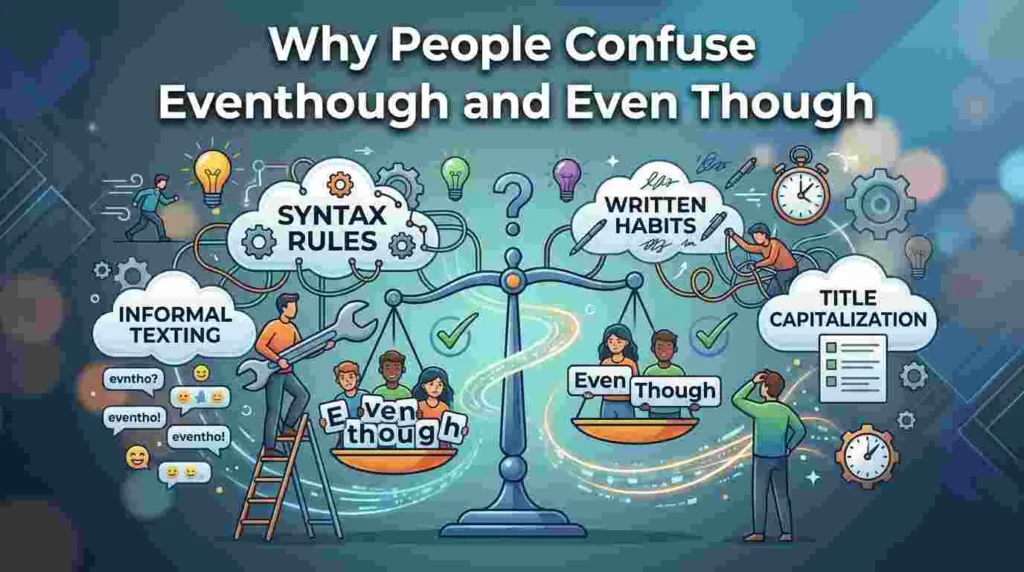
The confusion happens because:
- Native speakers pronounce the phrase quickly.
- Many compound words exist in English.
- Spell-checkers sometimes fail to notice the mistake.
- Beginners assume it should be one word.
Remember: It is always written as two words.
Even though vs. Even Though: Comparison Table
| Question | Correct Answer |
| Is “even though” a word? | No |
| Is “even though” correct? | Yes |
| Can both be used interchangeably? | No |
| Which one appears in dictionaries? | Even though |
| Which should you use in exams? | Even though |
Even though vs. Even Though: Grammar Guide
Even though is a subordinating conjunction.
It joins a dependent clause with an independent clause to express contrast.
Pattern:
Even though + subject + verb, main clause
Example:
- Even though she was sick, she attended class.
or
Main clause + even though + subject + verb
Example:
- We finished the project even though it was difficult.
How each term is used in sentences
Eventhough
This form should not be used.
❌ Even though I was tired, I continued.
Correct version:
✅ Even though I was tired, I continued.
Even Though
Correct examples:
- Even though he apologized, she remained upset.
- We played football even though it was cold.
- Even though the task was difficult, they succeeded.
- I enjoyed the movie even though it was long.
- Even though she studied hard, the exam was challenging.
Common mistakes learners make
- Writing even though as one word.
- Confusing even though with even if.
- Omitting the second word, though.
- Using eventhough in academic essays.
- Assuming pronunciation determines spelling.
Simple rules to remember
- Always write even though as two separate words.
- Think of it as even + though.
- If you mean although, use even though.
- Never combine the words.
Quick tips for writing and speaking
- Pause mentally between even and though while writing.
- Proofread for spacing mistakes.
- Replace although with even though if stronger emphasis is needed.
- Never trust pronunciation for spelling.
Even though vs. Even Though: When to Use Each One
Use Even though
Never.
It is considered incorrect in every type of English writing.
Use Even Though
Use it when:
- showing contrast
- writing essays
- writing emails
- academic assignments
- business reports
- conversations
- storytelling
- presentations
- blogs
- professional communication
Examples:
- Even though the meeting ended late, everyone stayed positive.
- Even though prices increased, sales improved.
Even though vs. Even Though: When NOT to Use Each One
Do not use even though:
- in essays
- in exams
- in emails
- in reports
- in books
- in articles
- in presentations
Do not use even though when you mean:
- even if (possible condition)
- because (reason)
- therefore (result)
Even though vs. Even Though: Which One to Use (Decision Guide)
Use this simple guide:
If you want to express contrast:
→ Use even though.
If you accidentally write one word:
→ Change it to even though.
If you’re writing professionally:
→ Always use even though.
If you’re unsure:
→ Ask yourself whether although fits. If yes, even though is correct.
Even though vs. Even Though: Real-World Practical Examples
Even though Examples
These are incorrect examples for learning purposes.
- ❌ Eventhough I was busy, I finished my homework.
- ❌ Eventhough the weather changed, we continued hiking.
- ❌ Even though profits fell, the company expanded.
- ❌ Even though technology improved, mistakes happened.
- ❌Even though she practiced daily, she felt nervous.
Even Though Examples
- Even though I was tired, I completed my assignment. (Education)
- Even though traffic was heavy, we arrived on time. (Daily life)
- Even though the experiment failed, researchers learned valuable lessons. (Science)
- Even though competition increased, the business remained profitable. (Business)
- Even though the software crashed, the files were recovered. (Technology)
Self-Assessment (Fill in the Blanks)
- I will use ______ when referring to a contrast in writing.
The correct word is ______ because it is grammatically correct. - I will use ______ before a dependent clause.
The correct word is ______ because it joins contrasting ideas. - I wrote ______ in my essay by mistake.
The correct word is ______ because one-word spelling is incorrect. - We continued walking ______ it started raining.
The correct word is ______ because it expresses contrast. - She smiled ______ she felt nervous.
The correct word is ______ because the sentence contrasts emotions. - ______ is accepted in dictionaries.
The correct word is ______ because it is the standard spelling. - I should never write ______ in an exam.
The correct word is ______ because the first form is misspelled. - ______ is written as two words.
The correct word is ______ because English grammar requires a space. - We finished the meeting ______ everyone was tired.
The correct word is ______ because it links contrasting ideas. - My teacher corrected ______ to the proper spelling.
The correct word is ______ because only one form is correct. - I succeeded ______ the task was difficult.
The correct word is ______ because it shows contrast. - ______ is not a valid English word.
The correct word is ______ because dictionaries do not recognize it. - Use ______ in formal reports.
The correct word is ______ because it is grammatically correct. - She attended school ______ she had a cold.
The correct word is ______ because it introduces a contrasting clause. - ______ should always be avoided.
The correct word is ______ because it is a spelling mistake. - Writers prefer ______ in professional documents.
The correct word is ______ because it follows standard grammar. - The sentence is correct only with ______.
The correct word is ______ because it is the accepted form. - I recognized the error in writing ______.
The correct word is ______ because the combined form is wrong. - We enjoyed the picnic ______ it was windy.
The correct word is ______ because it expresses an unexpected situation. - Every English learner should remember to write ______ as two words.
The correct word is ______ because that is the standard spelling.
Answers
- even though / even though
- even though / even though
- eventhough / even though
- even though / even though
- even though / even though
- even though / even though
- eventhough / even though
- even though / even though
- even though / even though
- eventhough / even though
- even though / even though
- eventhough / even though
- even though / even though
- even though / even though
- eventhough / eventhough
- even though / even though
- even though / even though
- eventhough / eventhough
- even though / even though
- even though / even though
Even though vs. Even Though: Final Verdict
The comparison between eventhough and even though is simple once you know the grammar rule. Eventhough is not a correct English word and should never be used in any type of writing. Even though, written as two separate words, is the correct subordinating conjunction used to express contrast between two ideas. Whether you’re writing an academic paper, business email, blog post, or casual message, always choose even though. Remember this easy rule: if you mean “although,” write “even though”—never “eventhough.” Following this rule will improve your grammar, make your writing more professional, and help you avoid one of the most common spelling mistakes in English.
Conclusion
Understanding the difference between Eventhough Vs Even Though is much easier once you know that only even though is the correct form in standard English. While eventhough may seem acceptable because of how the phrase sounds in conversation, it is simply a spelling mistake and should be avoided in all types of writing. Using even though correctly helps you express contrast clearly, making your sentences more natural and grammatically accurate.
Whether you are writing an essay, business email, academic assignment, blog post, or everyday message, choosing the correct form improves readability and leaves a professional impression. By remembering that even though is always written as two separate words, you can avoid one of the most common English spelling errors. With regular practice and careful proofreading, you’ll confidently use even though in the right context and strengthen your overall English writing and communication skills.
FAQs
Is eventhough a correct English word?
No, eventhough is not a correct English word. It is a common spelling mistake made by combining even and though into one word. In standard English, the correct form is even though, written as two separate words in every type of writing.
Is even though one word or two words?
Even though is always written as two separate words. It functions as a subordinating conjunction that introduces a contrasting idea. Writing it as one word is considered incorrect in formal, academic, and everyday English.
What does even though mean?
Even though means even though or although. It connects two ideas that contrast with each other. It is commonly used to show that one situation happens regardless of another circumstance.
Can I use eventhough in academic writing?
No. You should never use eventhough in academic writing because it is not recognized as a correct English word. Teachers, editors, and grammar checkers will treat it as a spelling error. Always write even though instead.
Is even though the same as although?
Yes, even though and although have very similar meanings because both introduce contrasting ideas. However, even though often adds slightly stronger emphasis to the contrast, making it useful when you want to highlight an unexpected situation.
Why do people write eventhough instead of even though?
Many people write eventhough because the phrase is often pronounced quickly in speech, making it sound like one word. This pronunciation can lead learners to combine the words, even though standard English always keeps them separate.
Can even though start a sentence?
Yes, even though can begin a sentence. When it introduces a dependent clause at the beginning, it is usually followed by a comma before the main clause. This structure is common in both formal and informal writing.
Is even though a conjunction?
Yes. Even though is a subordinating conjunction. It connects a dependent clause with an independent clause while showing contrast between the two ideas. It plays an important role in creating clear and grammatically correct complex sentences.
How can I remember the correct spelling of even though?
A simple trick is to remember that even and though are two separate words with their own meanings. If you can replace the phrase with although, then you should write even though as two words, never as one.
Which form should I always use: eventhough or even though?
You should always use even though because it is the only grammatically correct form in English. Avoid eventhough in emails, essays, reports, blogs, exams, and everyday writing to ensure your work looks accurate and professional.